Infographics to support Indigenous peoples and communities were developed as part of a partnership in consultation with the First Nations Health Authority, the BC Association of Aboriginal Friendship Centres, Métis Nation British Columbia, and Indigenous and non-Indigenous staff of the BC Centre for Disease Control. You can view and download the infographics here:
Everyone can be affected by wildfire smoke and should take action to reduce their exposure. Some people are at higher risk of experiencing severe or long-term health effects, including:
- People with pre-existing chronic conditions such as asthma, chronic obstructive pulmonary disease (COPD), heart disease, and diabetes
- People who are pregnant
- Infants and small children
- Elderly
Health effects of wildfire smoke
Wildfire smoke contains very small particles that travel deep into your lungs when you inhale. These particles can cause irritation and inflammation, which can last until the air quality improves. Most symptoms are relatively mild, and can be managed without medical attention:
- Sore throat
- Eye irritation
- Runny nose
- Phlegm production
- Wheezy breathing
- Headaches
Some people may experience more severe symptoms and should seek prompt medical attention. Call
HealthLink BC (8-1-1), talk to your primary care provider or visit a walk-in clinic if you’re experiencing:
- Shortness of breath
- Severe cough
- Dizziness
- Chest pain
- Heart palpitations
There is also a growing body of evidence that wildfire smoke exposure can have long-term health effects. Exposure during pregnancy and early childhood can affect lung and immune system development. Repeated exposure can affect brain health and has been associated with an increased risk of dementia. Evidence also indicates that long-term or repeated exposure may increase the risk of certain cancers.
The best way to protect against the potentially harmful effects of wildfire smoke is reduce your exposure to smoke and seek cleaner air:
-
Get prepared for the wildfire smoke season as you would do in any other summer.
- Use a
portable HEPA air cleaner or a
do-it-yourself air cleaner to filter the air in one area of your home.
- Visit public spaces such as community centres, libraries, and shopping malls which tend to have cleaner, cooler indoor air.
- Take it easy and
limit outdoor exercise on smoky days because the harder you breathe, the more smoke you inhale.
- Drink lots of water to help reduce inflammation.
- If you need to be outdoors, consider wearing
a well-fitted N95/KN95/KF94 respirator to filter the air you breath in.
- Whenever possible, use air conditioners, heat pumps, evaporative coolers, fans, and window shades to keep your cleaner air space comfortably cool on hot days. Overheating can cause serious health problems.
- If you have a chronic health condition, work with your health care providers to create
a management plan for smoky conditions. If you use rescue medications, make sure that you have an ample supply at home and always carry them with you during the wildfire season.
- Use the
Air Quality Health Index (AQHI) or
AQMap to evaluate local and regional air quality conditions.
The composition of wildfire smoke
Wildfire smoke is a complex mixture of gases and particles that interact and change as they move away from the fire. The individual particles in wildfire smoke are very small, but they tend to stick together as they travel away from the fire. Of all the pollutants in wildfire smoke, fine particulate matter (PM2.5) poses the greatest risk to human health.
The microscopic soot particles can be inhaled deep into the lungs, where they may cause inflammation and irritation. Volatile organic compounds and other gases can also irritate the eyes, nose, throat, and lungs.
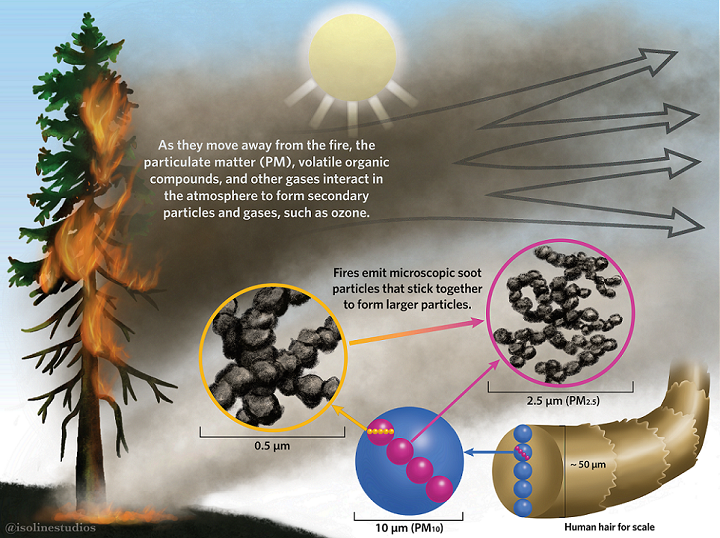
Download and use the image. Credit: Jen Burgess/IsolineStudios for BC Centre for Disease Control.
Wildfire smoke and health surveillance dashboard
The
BC Asthma Prediction System provides information about (1) observed and predicted air quality, and (2) observed and predicted asthma-related health outcomes for BC Health Service Delivery Areas (HSDAs) and Local Health Areas (LHAs). The forecast predictions cover today and tomorrow. This information is intended to help BC public health professionals and the public anticipate and prepare for wildfire smoke events.
Translated Content
繁體中文 (Traditional Chinese)
简体中文 (Simplified Chinese)


